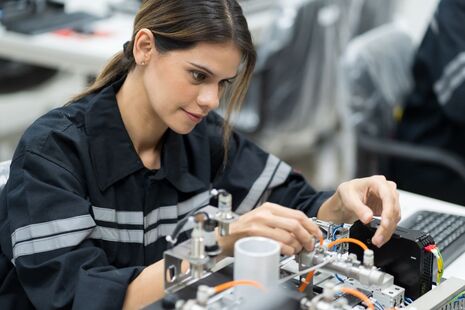



When a packaging line stops, the whole plant waits for the same person. In French-speaking Switzerland, industrial maintenance technicians work in pharma, watchmaking, food processing and machine tools, under job titles that change from one advert to the next: maintenance technician, service technician, maintenance mechanic, automation technician.
The figures on this page come from public sources dated 2025 and 2026: the Federal Statistical Office (FSO), SECO, Swissmem, Suva and the State Secretariat for Migration, plus the salaries reported by 2,192 professionals on a large Swiss job portal.
What does an industrial maintenance technician do?
An industrial maintenance technician keeps production machines and installations running: preventing breakdowns, diagnosing them and repairing them. The work falls into four families of tasks.
- Preventive maintenance: inspection rounds, lubrication, planned replacement of wear parts, each job logged in the CMMS.
- Corrective maintenance: mechanical, electrical, pneumatic or hydraulic fault-finding, then restart.
- Adjustments at batch or format changeovers.
- Improvement: modifying the machine that always fails in the same place, documenting the change, training the operators.
Safety is part of the job on the same footing as technical skill. Suva attributes close to 20% of occupational accidents to maintenance work, and more than ten people die doing it each year. Its eight vital rules for maintenance come down to this: stop the installation, secure it and neutralise residual energy before putting your hands in. A candidate who can describe a lockout procedure in an interview earns credit that diplomas do not give.
The sector shapes the working day. In pharma, every intervention is documented and justified. In watchmaking, tolerances are counted in microns. In food processing, shift work and cleaning cycles set the schedule.
Which qualifications and certifications lead to the job in Switzerland?
No single diploma leads to the role. Employers hire holders of a technical apprenticeship diploma (CFC) first, then look at experience on machines comparable to their own.
| Qualification | Duration | Entry route |
|---|---|---|
| CFC polymechanic (polymécanicien/ne) | 4 years | Apprenticeship after compulsory school |
| CFC automation technician (automaticien/ne) | 4 years | Apprenticeship in a company or at a school |
| CFC production mechanic | 3 years | Apprenticeship |
| CFC automation fitter | 3 years | Apprenticeship |
| Federal certificate in maintenance (agent/e de maintenance, brevet fédéral) | 1 to 2 years, part-time alongside work | Technical CFC and at least 2 years of maintenance practice |
| Technician, college of higher education (ES): mechanical engineering, industrial systems, electrical engineering | 2 to 3 years | CFC in the field |
| Advanced federal diploma in facility management and maintenance | Modular examination | Federal certificate or tertiary qualification and 2 years of experience |
The eight technical occupations of the sector were revised under the FUTUREMEM reform, and the first apprentices trained under the new curricula started in the 2026 school year. For federal examinations, the Confederation refunds half of preparatory course fees, up to CHF 9,500 for a federal certificate, once the exam has been sat, whether passed or failed.
The skills that get people hired
Mechanics, electrical engineering, pneumatics, hydraulics, reading diagrams, PLC diagnostics: the technical list is well known. Autonomy and the ability to explain a breakdown to a production manager in a hurry weigh as much, because technicians often work alone, sometimes at night.
The electrical authorisation foreign candidates discover late
The Low-Voltage Installations Ordinance (OIBT) restricts work on electrical installations to authorised persons. For in-house maintenance, the company applies to the Federal Inspectorate for Heavy Current Installations (ESTI) for a limited authorisation under Art. 13 OIBT, which names the employees concerned. The conditions: an electrician's CFC and three years of practice, a related CFC and five years of practice, or a pass in the ESTI examination. An electrical accreditation obtained in France or elsewhere does not replace this authorisation. The reference standard is NIBT 2025, in force since 1 January 2025.
The job market in French-speaking Switzerland, without the gloss
The market is decent, not euphoric. In August 2026, SECO counted 141,544 registered unemployed, a rate of 3.0%, up 7.1% on the year. The tech industry employed 324,200 people in the first quarter of 2026 according to Swissmem. In the first half of the year its order intake rose by 12.1% and its sales by 2.5%, with plants running at 81.1% of capacity against a long-term average of 85.6%. Watchmaking employed 64,807 people at 30 September 2025, 835 fewer than a year earlier: headcount fell in Vaud and Neuchâtel and rose by 3.0% in Geneva.
The Adecco Group's skills shortage index, published in November 2025, dropped by about 22% in a year, and by 17% in Latin Switzerland. It still ranks electricians and electronics technicians, a category that includes electromechanics and service technicians, fourth nationally among shortage occupations. In Latin Switzerland, only the health professions show a clear shortage.
In the searches we run at Fed Engineering, employers in French-speaking Switzerland find mechanics. They struggle more to hire people who can fix the electrical cabinet and the mechanics in the same call-out. No maintenance occupation appears on the 2026 list of occupations subject to the job vacancy notification requirement, which is reserved for occupations with unemployment of 5% or more.
Two types of contract open the door: the permanent contract and the temporary assignment, which some companies use as an observation period before hiring. The role does not lend itself to part-time work once it includes on-call duty.
How much does a maintenance technician earn, depending on the place of work?
The average self-reported gross salary is CHF 74,100 a year for Switzerland, with a gap of about ten thousand francs between the French-speaking cantons. The table shows salaries reported for full-time work, 13th month and bonuses included, as consulted on 3 October 2026.
| Region | Average self-reported gross annual salary | Number of salaries |
|---|---|---|
| Switzerland | CHF 74,100 | 2,192 |
| Zurich | CHF 81,888 | 133 |
| Neuchâtel | CHF 80,000 | 118 |
| Vaud | CHF 77,853 | 308 |
| Fribourg | CHF 75,400 | 109 |
| Valais | CHF 74,050 | 66 |
| Geneva | CHF 70,000 | 279 |
| Jura | CHF 69,800 | 42 |
Geneva below the national average is a surprise. The sample is self-reported and mixes industry, building services and the service sector: treat these amounts as orders of magnitude, above all in Valais and Jura where responses are few. The same source puts pay at CHF 68,983 with no experience and 87,349 at the top of the curve, a 27% rise over a career. The best-paying sectors are medical technology (86,500) and chemicals and pharma (84,102). For context, the FSO reports a Swiss median wage of CHF 7,024 gross a month in 2024 across all occupations, 7,632 in the machinery industry and 10,159 in pharma.
The collective agreement minimum says little about the market
The collective employment agreement of the MEM industries, valid until 30 June 2028, sets minimum wages by region. In 2026, for unskilled staff: CHF 4,163 a month in region A (Geneva, Lausanne, Nyon, Morges), 3,892 in region B (Fribourg, Valais) and 3,728 in region C (Neuchâtel, Jura, Jura-Nord vaudois), paid thirteen times. Skilled staff receive CHF 300 more.
The sum for a CFC holder in Lausanne: 4,463 x 13 = CHF 58,019 a year. The average reported salary in Vaud exceeds that floor by 19,834 francs. In Neuchâtel, a canton placed in the lowest region, the reported average is the highest in French-speaking Switzerland. Negotiating from the agreement minimum means undervaluing yourself. The agreement matters for other reasons: a 40-hour week, a 13th month, 25 days of holiday up to age 39, 27 from 40 to 49 and 30 from 50. It binds signatory companies only.
Example: ten nights of cover in a year
A technician paid CHF 6,000 a month for a 40-hour week is called in for ten nights during the year, eight hours each time. Hourly rate: 6,000 / 173.33 = CHF 34.62. The Employment Act grants a supplement of at least 25% for temporary night work (Art. 17b), or 8.65 an hour. Over 80 hours, that comes to about CHF 692 gross. From 25 nights in a calendar year, night work counts as regular and the law provides time off equal to 10% of the hours worked, with no compulsory cash supplement.
How to find a maintenance technician job in Switzerland
A job search is won on the precision of the application. An industrial recruiter is looking for machines, brands and breakdowns solved.
- Choose your search region by industry. Watchmaking and microtechnology in the Jura Arc and Geneva, pharma and biotech around Lake Geneva and in Valais, food processing in Vaud and Fribourg.
- Rebuild your CV around the machine base. Types of equipment, PLC brands, CMMS used, electrical authorisations, shift or on-call work. The conventions of a Swiss CV apply: photo, languages, references.
- Combine channels. On job portals, set the filters for place of work, workload percentage and contract type, then create a job alert. A specialist recruitment agency gives access to unadvertised roles. Fed Engineering's maintenance jobs cover French-speaking Switzerland.
- Prepare one breakdown to tell. Symptom, diagnosis, cause, length of the stoppage, action taken so it does not happen again. Add a sentence describing your ideal role: production troubleshooting, planned maintenance or new installations.
- Warn your referees. Swiss employers call them, and read work certificates.
Permits, foreign diplomas, languages: working in Switzerland when you come from abroad
For EU and EFTA nationals, the permit follows the contract. A contract of three months to one year gives an L permit; a contract of one year or an open-ended contract gives a B permit valid for five years. The G permit is for cross-border commuters, who return to their home abroad at least once a week; border zones have been abolished. For third-country nationals, the Federal Council kept the 2026 quotas at 4,500 B permits and 4,000 L permits, reserved for managers, specialists and other qualified workers, after a check that no worker in Switzerland or the EU is available. A technician's application rarely passes that filter.
Because the occupation is not regulated, SERI states that the holder of a foreign diploma can apply directly: the employer judges the value of the training. A level certificate exists and is optional. We found no official equivalence between a French BTS in maintenance and a Swiss qualification.
French is enough in most workshops in French-speaking Switzerland. German becomes an asset when the head office or the machine builder is in German-speaking Switzerland, English when the site belongs to an international pharmaceutical group. The working culture rests on autonomy: a technician is expected to report a problem before being asked.
Industry 4.0: what predictive maintenance changes in the job
Switzerland had 294 industrial robots per 10,000 manufacturing employees in 2024, tenth in the world according to the International Federation of Robotics. Plants are equipping themselves; data processing follows more slowly. In a 2024 survey by ETH Zurich with Swissmem covering more than 200 companies, about 10% were running artificial intelligence pilot projects and more than half had not yet considered AI in production.
Predictive maintenance is therefore still the exception on the shop floor, and troubleshooting keeps its place. The technician who gets ahead can do three more things:
- read data from a vibration or temperature sensor and turn it into a decision to intervene;
- connect to a PLC, including remotely;
- apply the plant's cybersecurity rules.
That last point has carried weight since 1 April 2025: operators of critical infrastructure must report a cyberattack within 24 hours, with fines of up to CHF 100,000 since 1 October 2025. The duty does not cover every factory, but it has brought the subject into the maintenance procedures of the sites concerned.
Career development: from troubleshooting to leading a team
After a few years, three routes open up. The first leads to management, from team leader to maintenance manager, with the federal certificate and then the advanced federal diploma as milestones. The second runs through specialisation in automation or robotics, often via a college of higher education. The third leads to methods and new installations. Pay potential follows: reported salaries rise by 27% between the start and the end of a career, more for those who take on a team. The move from technician to manager in Switzerland is prepared before the promotion: team leadership training, first stints covering for the workshop manager.
FAQ: maintenance technicians in Switzerland
Is a French BTS in maintenance recognised in Switzerland?
No recognition is required, because the occupation is not regulated. The employer alone decides what the diploma is worth. Only work on electrical installations requires a Swiss authorisation.
Do you need German to work in French-speaking Switzerland?
Not for most roles. German matters when the machine documentation or the company's head office is in German-speaking Switzerland.
Is on-call duty limited by law?
Yes. Ordinance 1 to the Employment Act limits on-call duty to a maximum of seven days in any four-week period (Art. 14 OLT 1).
Are "technicien de maintenance" and "agent de maintenance" the same thing?
In job adverts, often yes. Strictly speaking, agent de maintenance is the title of the holder of the federal certificate, a qualification above the CFC.
Read also
- Automation technician in Switzerland: pay and career path
- Industrial robotics in Switzerland: market, ecosystem and careers
- Industrial cybersecurity in Switzerland: the 2026-2027 deadlines
- Microtechnology in Switzerland: salaries and careers
- Net salary in Switzerland for cross-border workers
Official sources
- Federal Statistical Office: wages, income from employment and labour costs
- SECO: unemployment figures
- Swissmem: the MEM collective employment agreement (in French)
- orientation.ch: federal certificate in maintenance (in French)
- SERI: federal contributions for preparatory courses
- SERI: recognition of foreign qualifications
- Fedlex: Low-Voltage Installations Ordinance, OIBT (in French)
- Fedlex: Employment Act
- Suva: preventing accidents during maintenance work (in French)
- State Secretariat for Migration: work and permits